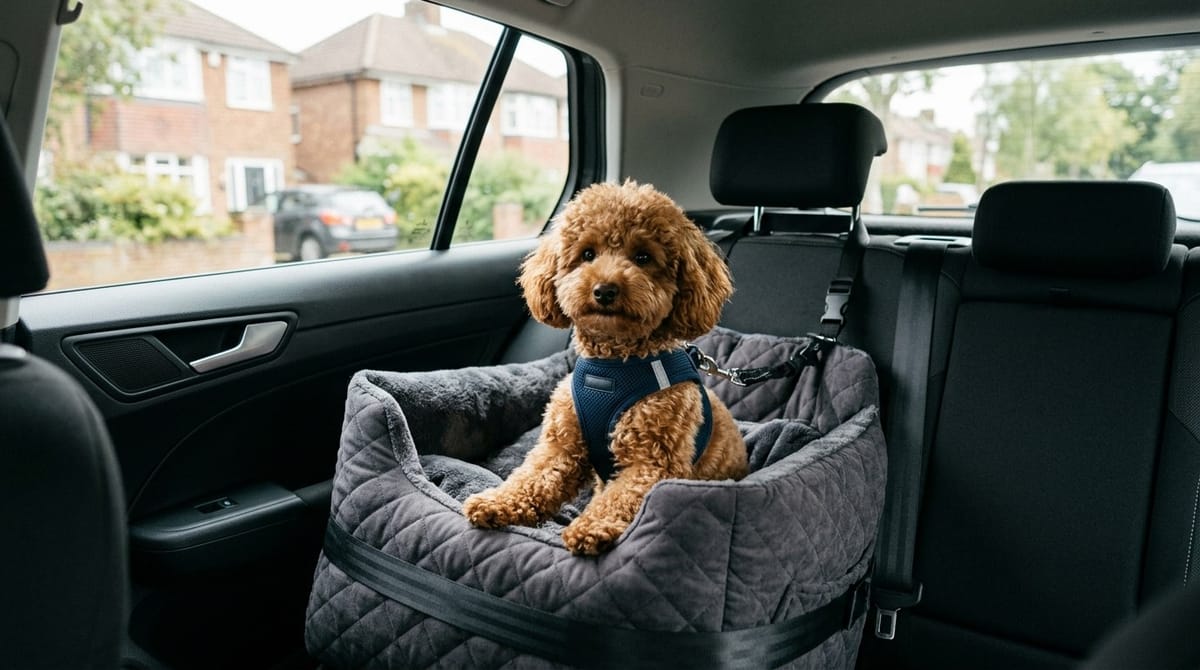
Comparison · 3 picks
Best Dog Car Seats UK: ISOFIX Seats and Boosters Compared
Affiliate disclosure: This article contains affiliate links. If you click through and buy a product we will earn a small commission at no extra charge to you. As an Amazon Associate I earn from qualifying purchases.
The best dog car seat for a UK owner depends on what the seat is for. A booster lifts a small dog to window height for comfort; a rigid ISOFIX seat or carrier contains the dog in a sudden stop. Only the second job involves crash protection, and the evidence behind it is thinner than most listings suggest.
The Center for Pet Safety (CPS, a US non-profit that crash-tests and certifies pet travel products) certifies three kinds of product: safety harnesses, pet travel carriers and travel crates. Its certified list, as read on 18 November 2026, has no category for car seats or boosters. When CPS crash-tested popular pet travel seats in its 2015 pilot study, it concluded that a seat can stop a dog distracting the driver but is unlikely to protect it in a crash, and it advised owners to use a crate, carrier or certified harness instead (Subaru of America, the study's sponsor).
So this page ranks four seats on two separate questions: how well each holds and contains the dog, and what crash evidence its maker publishes. None of the four is CPS certified, and we say who ran each crash test.
Are dog car seats crash tested?
Independent certification versus the maker's own test
Not independently. A "crash tested" label on a dog car seat describes a test the maker commissioned, against criteria the maker chose. Three claims come up most in the UK:
- Tavo Maeve ISO. Tavo, a pet travel brand, says the seat is crash-tested and benchmarked against UN ECE R129, the European i-Size child-seat regulation. Benchmarked is not certified: R129 approval applies to child seats, and no approval body certifies a dog seat to it.
- 4pets Caree. 4pets (a European maker of dog transport boxes and carriers) sells the Caree as crash-tested and approved by the German TÜV testing organisation, according to its UK retailer.
- PupSaver. The US maker of this rear-facing booster says it was crash tested at MGA Research Corporation and passed a 35 mph sled test (PupSaver). That is a maker-commissioned test, not CPS certification. Its Amazon UK listing showed no buying option on 19 November 2026, so it is no longer one of our picks.
If independent certification matters most, the CPS route for a small dog is a certified carrier secured on the back seat, such as the Sleepypod Atom, Sleepypod Air or Sleepypod Mobile Pet Bed, or a certified harness such as the Sleepypod Clickit Sport Plus. Sleepypod is a US brand, so check UK delivery before ordering a carrier. Our dog car harness comparison lists every CPS-certified harness and where to buy it in the UK.
Can a dog car seat use ISOFIX?
Which dog seats are built for ISOFIX, and why you never improvise a connection
Yes, when the maker built it for ISOFIX. ISOFIX (the international standard for rigid child-seat anchor bars, built into the rear seats of most modern cars) gives a stiffer connection than a seat belt, which is why two UK-sold dog seats now use it:
- Tavo Maeve ISO. Integrated ISOFIX latches lock the seat straight onto the car's anchor bars, with no separate base. The iso5X size takes pets up to 13.6 kg. Tavo also sells a separate ISOFIX base with a stability leg for its standard Maeve carrier, which Halfords lists for pets up to 13.6 kg.
- 4pets Caree. The carrier fits with the seat belt and headrest as standard; an optional ISOFIX connector set, approved for up to 15 kg, adds the rigid fixing.
The rule that keeps ISOFIX safe is simple: use only the connectors the maker supplies and tested. Clipping a booster tether or a harness lead to an ISOFIX bar puts the crash load through a path nobody tested. Seat-belt boosters such as the Snoozer Lookout II, and every dog car harness, are designed around the seat belt, so keep them there.
Who needs a dog car seat at all?
When a booster is the right answer and when a harness is enough
A dog car seat earns its place in three situations. First, small dogs (under about 9kg) who get motion sick on standard car journeys often settle when raised to window-view height. Second, anxious travellers who chew, scratch, or pace can be calmer in a contained pod that limits their range of movement without a crate's bulk. Third, breeds with short legs and long backs (Dachshunds, Corgis, Bassets) benefit from the softer landing of a padded booster compared to a flat seat.
If your dog is over about 15kg, travels happily on the back seat, and shows no signs of anxiety, a crash-tested harness alone is usually the right choice. Boosters cap out for size and become a constraint rather than a comfort once a dog can't turn around comfortably.
At a glance
All 3 options side by side.
| Tavo Maeve ISO Pet Car Seat | 4pets Caree Small Pet Carrier | Snoozer Lookout II Pet Car Seat | |
|---|---|---|---|
| Price | £350 | £269.95 | See price |
| Best for | Best ISOFIX dog car seat. | Best for small dogs up to 15 kg. | pair it with a well-fitted harness, ideally a CPS-certified one. |
| Review | Read review → | Read review → | Read review → |
| Buy |
The picks in detail
Tavo Maeve ISO Pet Car Seat
Bottom line. Best ISOFIX dog car seat. The Maeve ISO is the one dog seat here that locks to the car's ISOFIX bars on its own latches, and its rigid shell does a container's job rather than a booster's. Pick it for a small dog on regular motorway trips if your car has ISOFIX. Its crash claim is a maker benchmark against a child-seat standard, not CPS certification.
Pros
- Integrated ISOFIX latches lock to the car with no separate base
- Rigid shell contains the dog rather than just lifting it
- Tavo says it is crash-tested and benchmarked against child-seat regulation UN ECE R129
Cons
- £350 at the time of writing, the most expensive seat here
- The iso5X size stops at 13.6 kg
- The crash test is Tavo's own; no independent certification
4pets Caree Small Pet Carrier
Bottom line. Best for small dogs up to 15 kg. The Caree is a closed carrier that sits on a passenger seat, held by the seat belt and headrest or by ISOFIX with its connector set. Two side doors let you load the dog from either side of the car. Choose it over the Tavo for a slightly heavier small dog, or when you want one carrier that also lifts out of the car.
Pros
- Sold as crash-tested and approved by the German TÜV
- Takes dogs and cats up to 15 kg
- Fits with the seat belt as standard, or ISOFIX with an optional £39.95 connector set
Cons
- £269.95 at the time of writing, plus the ISOFIX connector
- Not designed for use in the boot
- TÜV approval is the maker's claim; no CPS certification
Snoozer Lookout II Pet Car Seat
Bottom line. Best booster for window-view comfort. The Lookout II, from US maker Snoozer, is a long-standing choice for lifting a small dog to window height, and a calmer dog distracts the driver less. It is a comfort seat, not crash protection: pair it with a well-fitted harness, ideally a CPS-certified one.
Pros
- Raises a small dog to window height, which settles many anxious travellers
- Snoozer rates the standard size to 25 lb (about 11 kg) and the Large to 34 lb (about 15 kg)
- Seat-belt fitting suits any car, with or without ISOFIX
Cons
- A comfort booster: no published crash test
- The Large size rides on the back seat only
- The dog still needs a harness clipped to the tether
How do I size a dog car seat?
The boundary that decides whether a booster works at all
The single most important number is your dog's weight when relaxed (not standing tense on the scales). Add a kilogram for paws-up fidgeting in the seat. Then check the manufacturer's weight limit, not the size descriptor. Some 'large' boosters cap at 9kg; some 'small' models take 13kg. Names lie, kilograms do not.
The second number is internal floor length: measure the dog from sternum to base of tail with them lying flat. A booster shorter than that length means the dog rides curled rather than relaxed. For a 30-minute commute that does not matter; for a four-hour drive to the Lake District it matters a lot.
Where should a dog car seat go in the car?
The rear seat, and the front only with the airbag off
Does my dog need a harness in a car seat?
Which dog car seat should I buy?
Three picks for three jobs
For a small dog on regular motorway trips in a car with ISOFIX, the Tavo Maeve ISO is the most secure seat here. For a small dog up to 15 kg, or a car without ISOFIX, the 4pets Caree does the same containing job on the seat belt. For an anxious dog that settles at window height, the Snoozer Lookout II is the comfort pick, paired with a harness.
If your dog is over 15 kg or travels calmly on the back seat, a crash-tested harness on its own is the right call, and a CPS-certified harness is the strongest evidence-backed choice. Combine either approach with a packable travel water bottle and motorway service-stop planning from our dog-friendly motorway services guide.
When to Replace a Dog Car Seat
Soft signals that the booster has done its job
Dog car seats do not have a fixed expiry date the way child seats do, but they do degrade. Three signs say it is time to replace the booster: the foam padding compresses flat enough that the dog sits at seat-back height rather than window height, the tether webbing shows visible fraying or sun-bleached fibres, or the inner liner can no longer be cleaned to your satisfaction after a particularly muddy walk. None of these are urgent the way a crash-tested child seat would be, but a degraded booster stops doing the comfort and visibility job that justified the price tag.
If the booster has been involved in a sudden braking event hard enough that the tether absorbed real load, treat that as a replacement signal even when the visible damage is minor. The webbing inside the tether is what would protect the dog next time; stretched fibres have less reserve than fresh ones.
What does UK law say about dogs in cars?
What the Highway Code actually says
Rule 57 of the Highway Code says a dog or other animal should be suitably restrained so it cannot distract the driver or injure the driver or itself if the car stops quickly. It names four suitable restraints: a seat belt harness, a pet carrier, a dog cage or a dog guard. A booster is not on that list, so a dog in a booster needs a harness clipped to the booster's tether; a closed carrier such as the Caree or Maeve counts as a pet carrier.
Rule 57 carries no penalty of its own. A driver distracted by a loose dog can face a careless-driving charge, and an unrestrained dog can complicate an insurance claim, so check your own policy wording.
What changed in this update?
Rebuilt on 19 November 2026 around crash-test evidence and ISOFIX
- Crash evidence corrected. The PupSaver was described as having independent crash data; its test was commissioned by its maker, and it holds no CPS certification.
- ISOFIX seats added. The Tavo Maeve ISO and 4pets Caree, both sold by UK retailers, replace the claim that no dog seat uses ISOFIX.
- Unavailable picks removed. The PupSaver and Kurgo Skybox Amazon UK listings showed no buying option on 19 November 2026. The K&H and Outward Hound links pointed to different products from the ones described, so both were removed.